Short answer: For a tank heater, start with the number of people in your home, then check the first hour rating, which is how much hot water the unit can deliver in a busy hour. For a tankless heater, size by flow rate in gallons per minute and by how cold your incoming water is.
Rheem suggests about 30 to 40 gallons for 1 to 2 people and 40 to 50 gallons for 2 to 4 people.
Rheem suggests 50 to 55 gallons for 4 to 5 people, and 75 gallons or a tankless unit for 5 or more.
Running out of hot water on busy mornings usually means the unit is too small for how you live.
Not sure? Text Ryan how many people and bathrooms you have. A free estimate comes before any work.
Start With Your Household
Rheem gives these starting points for gas tank water heaters. Think of them as a first guess, not a final answer.
People in the home
Tank size to start with
1 to 2
30 to 40 gallons
2 to 4
40 to 50 gallons
4 to 5
50 to 55 gallons
5 or more
75 gallons, or a tankless unit
Rheem's guide for electric tank heaters is close. It suggests about 50 gallons for 3 to 5 people and 55 gallons or larger for 5 or more.
Two homes with four people can need very different heaters. One has everyone showering at 6 a.m. The other spreads it out. That is why the next step matters.
The Number That Matters More: First Hour Rating
ENERGY STAR defines the first hour rating as an estimate of the most hot water, in gallons, a storage water heater can supply in one hour that starts with the tank fully heated. It counts both the water stored in the tank and how fast the heater can warm more.
That is why a 40 gallon tank with a strong burner can beat a 50 gallon tank with a slow one. The rating is in the maker's specifications for each model, so you can compare units on the same footing.
If your current heater usually keeps up, ENERGY STAR says a same-size replacement may work. You can find the capacity on the nameplate or the yellow EnergyGuide sticker on the tank.
Count Your Busiest Hour
The best way to size a tank is to add up the hot water your home uses in its busiest hour, then pick a unit whose first hour rating covers it. Rheem's example for one busy hour is two showers at 30 gallons, one load of laundry at 20 gallons and kitchen use at 5 gallons. That adds up to 55 gallons.
Do the same for your home. Think about the worst morning of the week. Who showers, is the dishwasher running, is a load of laundry going? If your total is more than a unit's first hour rating, you will run out of hot water at the wrong time.
Want a second opinion on the size?
Text Ryan how many people live in your home, how many bathrooms you have, and a photo of the label on your heater now. He is a licensed Master Plumber and answers his own phone.
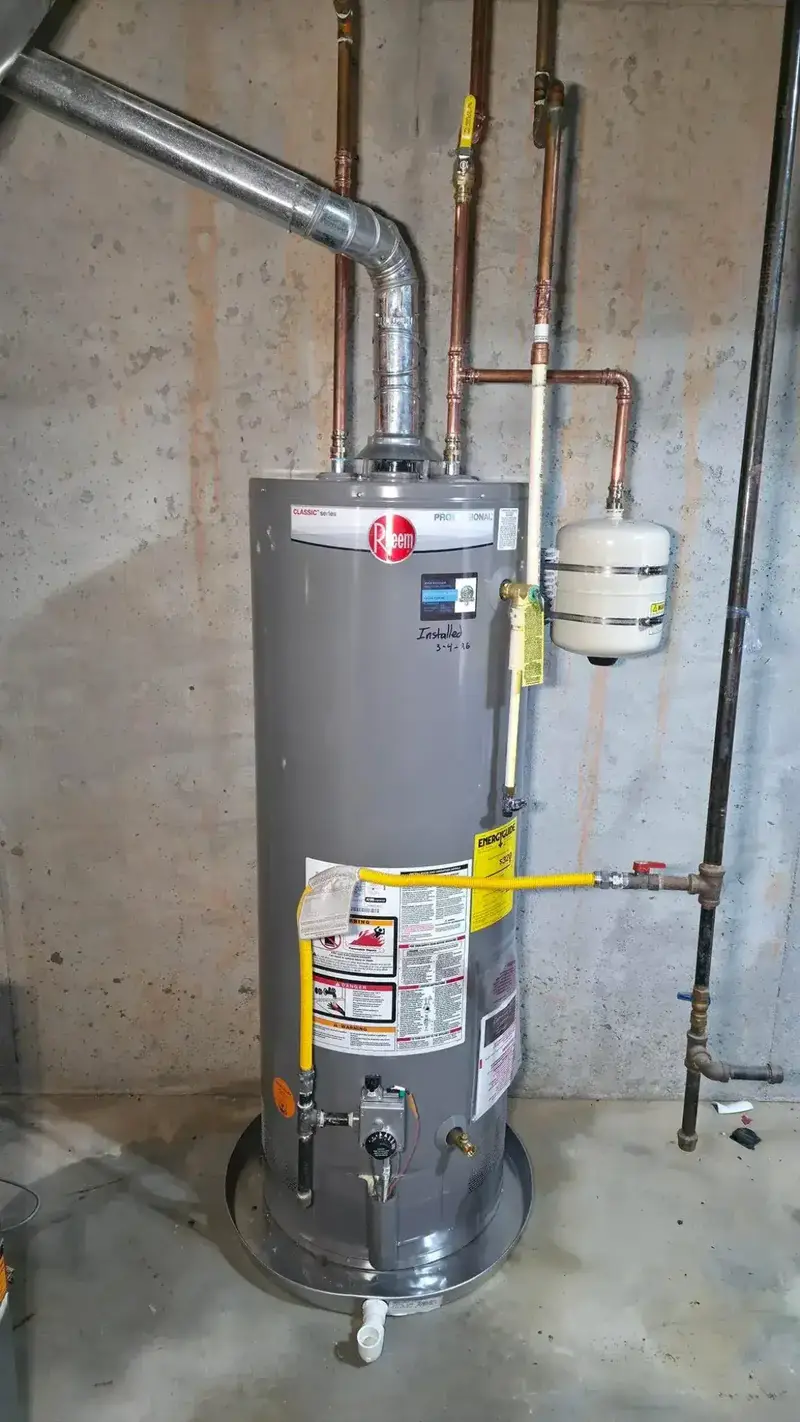
A tank water heater in a basement. The size is on the nameplate and the sticker on the side.
Sizing a Tankless Water Heater
A tankless heater has no tank, so gallons do not apply. ENERGY STAR says these models are rated by how many gallons of hot water they make per minute. You size one by adding up everything that might run at the same time.
ENERGY STAR lists these average flows:
Shower or bathtub: about 2.5 gallons per minute.
Clothes washer: about 3.3.
Kitchen or bathroom sink: about 2.2.
Dishwasher: about 1.3.
Add them up for your busiest moment. Two showers and a dishwasher running together come to about 6.3 gallons per minute (2.5 plus 2.5 plus 1.3). ENERGY STAR says to choose a larger rating if you often run a shower, dishwasher and washer at the same time.
There is also a floor. Rinnai says its units need a demand of at least 0.4 to 0.6 gallons per minute to turn on. A very thin trickle at a sink may not start the heater at all.
Cold Incoming Water Changes the Math
A tankless heater has to raise the temperature of the water as it passes through. Rinnai calls this the temperature rise: the difference between the temperature you set and the temperature of the water coming in. If you set 120 degrees and the water comes in at 60, the rise is 60 degrees.
The colder the incoming water, the harder the unit works, and the less hot water it can make per minute. Water in a winter pipe is colder than in summer, so a unit that keeps up in July can fall short in January. Size it for the cold months, not the warm ones. Our Navien versus Rinnai guide walks through the flow rate calculation in more detail.
What a Tankless Unit Needs Besides Flow
ENERGY STAR tells homeowners to have an installer confirm three things before a tankless swap:
Whether your gas line is big enough for the unit.
Whether there is electricity near the heater, for models that use a fan to vent.
How the exhaust gases will be vented.
These can change the price and the plan as much as the size does. Ryan installs gas lines in both propane and natural gas, so the line and the heater can be checked together. For more on the choice, see tankless water heater service and our tank versus tankless guide.
Signs Your Heater Is Too Small
You run out of hot water when two things run at once.
Hot water fades during a long shower.
You added people, a bathroom or a big soaking tub since the heater went in. Rheem notes that large households and soaker tubs may need a different unit.
Sometimes the cause is not size at all. A failing element or a tank full of sediment acts like a smaller tank. Our page on hot water that runs out fast helps you sort out which it is, and the lifespan guide tells you when age is the reason.
Mountain Homes: Space, Fuel and Water Supply
Size is only one part of the choice. In North Georgia, the fuel often decides what you can install. Homes without a natural gas line run on propane or electric. We cover that in gas, electric or propane water heaters.
On a private well, hot water also depends on your water pressure and flow. If your pressure is weak, a bigger heater will not fix it. Start with why hot water pressure is low. Where the heater lives matters too. A basement, closet or crawl space limits how tall or wide a tank can be, which is worth measuring before you shop.
What a Customer Said
★★★★★
"Ryan tells you what he is going to do, why he needs to do it and what it will cost. Then he shows up when he says he will, does the work correctly, neatly and quickly and bills with no surprises. I wish there were more people like Ryan in the world."
Lindy D.Google review, Feb 2025
Common Questions
Is a 40 gallon or 50 gallon tank better for a family of four?
Rheem lists 40 to 50 gallons for 2 to 4 people and 50 to 55 gallons for 4 to 5 people, so 50 gallons fits a family of four in both. Check the first hour rating against your busiest hour. If you take long showers or have a soaker tub, lean larger.
Can I put in a bigger tank than the one I have now?
Often yes, if it fits the space. A bigger unit can also need a different gas supply or electrical circuit, so have the installer check both before you buy. ENERGY STAR says a same-size replacement may work if your current heater usually meets your needs.
How do I find the size of my current water heater?
Look at the nameplate or the yellow EnergyGuide sticker on the tank. ENERGY STAR says the capacity in gallons is printed there. A clear photo texted to Ryan works too.
Will a tankless heater mean I never run out of hot water?
It will not run out as long as what you use at once stays under its flow rate. Run more fixtures than the unit can supply and the water cools. That is why you size it by gallons per minute and plan for cold winter water.
Does a bigger water heater cost more to run?
A larger tank has more water to keep hot, so it can use more energy than a smaller one. We do not have a number for your home. Matching the size to your real use is the goal. Ryan gives a free estimate before any work starts.