
Plumbing emergency? Burst pipe, no water, sewer backup. We respond day and night. Call or Text (706) 669-5727
Plumbing Problems
Water Heater Leaking From the Bottom
Water on the floor under a water heater is not something to sit on. But before you assume you need a new one, find out where the water is actually coming from. That one detail decides whether this is an hour of work or a replacement.
Shut the Water and the Power Off First
Diagnose second. Stop the feed first. There is a cold water shut-off valve on the line entering the top of the heater, usually on the right side. If it is a ball valve, turn the handle a quarter turn so it sits crosswise to the pipe. If it is a gate valve, turn it clockwise until it stops. If you cannot find it or it will not budge, go to the main shut-off for the house. Here is how to find and shut off your water main if you have never done it.
Then cut the energy to the unit. On an electric heater, flip the breaker labeled for it, usually a double-pole 30 amp. On a gas heater, turn the control knob on the front of the unit to OFF, or close the valve on the gas line running to it. Do not skip this. Electric elements that fire in a tank that has drained itself burn out in minutes, and a gas burner under a leaking tank is not something to leave running while you figure things out.
Those two steps take about ninety seconds and they take the panic out of the situation. Nothing gets worse while you look.
Where It Leaks From Decides Repair or Replace
Water finds the floor. It runs down the outside of a tank, pools at the base, and every leak on a water heater looks like a bottom leak from across the room. So get down and actually look. Wipe the whole unit dry with a towel, lay a strip of cardboard or a few paper towels under and around the base, and give it fifteen or twenty minutes. Whatever re-wets first is your source.
There are four places it comes from, and three of them are usually fixable:
- The T&P valve discharge tube, the pipe running down the side toward the floor. Usually repairable.
- The drain valve at the bottom front, the one that looks like a hose bib. Usually repairable.
- The cold inlet or hot outlet fittings on top. Usually repairable.
- The tank shell itself, water working its way out from under the jacket at the base. Not repairable. The unit gets replaced.
Leaking From the T&P Valve Discharge Tube
The temperature and pressure relief valve is a safety device screwed into the top or upper side of the tank, with a discharge tube running down and ending a few inches above the floor. If water is coming out the bottom of that tube, it is not coming through the tank wall. Two things cause it.
The first is that the valve is doing exactly its job. Pressure or temperature inside the tank climbed past its rating, typically 150 PSI and 210 degrees, and it opened to dump the excess. That is a warning worth listening to, not a nuisance drip. Something is driving the pressure up. The usual reason is thermal expansion in a closed system: water expands as it heats, a check valve or a pressure reducing valve stops it from pushing back into the supply, and with no working expansion tank to absorb it, the T&P is the only place the pressure can go. A dead expansion tank does the same thing. So does a thermostat stuck high.
The second is that the valve has simply failed. Mineral deposits build up on the seat until it stops sealing, so it weeps at normal pressure. On high-mineral well water, which is common through this part of North Georgia, valves crust up faster than most people expect.
Either way it is a repair, not a replacement. What you must not do is cap that tube or plug the valve to stop the drip. That valve is the only thing standing between an overheating tank and a genuine explosion. Never plug it, never cap it, never crank it down.
Leaking From the Drain Valve
The drain valve sits at the bottom front and looks like an outdoor spigot. It is there so the tank can be flushed. It fails two ways: it never got closed all the way after a flush, or the valve itself has gone. The plastic-bodied valves that come stock on a lot of tanks warp with heat cycling, and the washer inside hardens and stops sealing.
Because it sits at the very bottom, a drain valve drip lands directly under the tank and looks exactly like the worst case. Get low and watch it. If water is beading on the valve body or hanging off the spout, that is your leak and your tank is fine. Sometimes closing it fully or threading a hose cap onto the outlet stops it that minute. If the valve is shot, it gets replaced, and a brass one holds up far better than the plastic unit it came with.
Leaking at the Cold Inlet or Hot Outlet Fittings
Two connections sit on top of the heater, one bringing cold water in and one carrying hot water out. When either weeps, the water runs down the outside of the tank and pools at the base. Same story as the drain valve: it reads as a bottom leak until you look up.
The causes are a corroded nipple, a dielectric union that gave out, a failed flex connector, or a fitting that worked loose over years of the tank heating and cooling. Copper touching steel corrodes right at the joint, which is why dielectric nipples exist in the first place and why they are so often the part that lets go. All of it is repairable, and it is usually short work once the water is off.
Water Seeping From the Tank Shell Itself
This is the one that ends in a new heater. If the discharge tube is dry, the drain valve is dry, the top fittings are dry, and water is still showing up underneath, working out from under the metal jacket at the base, the inner tank has rusted through.
Here is the mechanism, because it explains why there is no fix. A tank water heater is a steel tank with a thin glass lining sprayed on the inside. That lining is never perfect. It leaves pinholes and hairline gaps from the day it was built. To protect the bare steel at those spots, the manufacturer hangs a sacrificial anode rod down inside the tank, usually magnesium or aluminum. The chemistry is simple: the rod is the more reactive metal, so it corrodes instead of the steel. Getting eaten is its entire job.
The rod is a consumable. It wears down over years and then it is gone. Once it is gone, the steel at every gap in that glass lining starts to corrode, and it corrodes from the inside out, where no one can see it. By the time water reaches the outside of the tank, the steel has already perforated. The puddle on your floor is the last chapter of a process that has been running quietly for a long time.
Well water speeds it up. High mineral and iron content makes the water more conductive, and the rod burns down faster in it. A rod that might go six years on treated water can be finished in three on an untreated mountain well. Figure 8 to 12 years for a tank unit here. If yours is in that window or past it and the water is coming from the shell, the age is not a coincidence.
A Seeping Tank Does Not Heal
This is the part people want to be wrong about, so here it is straight. A tank that is seeping does not seal back up. Corrosion does not run backward. The hole does not scab over. It gets bigger, because water pushing through a perforation keeps eroding the steel around it.
Today it is a damp spot you keep mopping. What it becomes is the perforation opening under pressure and the tank letting go all at once. A residential tank holds 40 to 80 gallons. That is the whole thing on your floor in a few minutes, and it does not stop there, because the cold supply keeps feeding the hole until somebody closes a valve.
Nobody can tell you whether a seeping tank has two weeks left or two months. It could go tonight. Failure like this is not on a schedule, which is why watching it and hoping is not a plan once water is already coming through. It matters more if the heater sits in a finished basement, a closet on a main floor, or an attic platform. And around Ellijay and Blue Ridge, plenty of cabins sit empty for stretches. A tank that lets go on a Tuesday in a vacation house nobody visits until Saturday is the expensive version of this, and the plumbing bill is the small part of it.
What a Replacement Actually Involves
The old tank gets drained and disconnected, hauled out, and the new one set in its place. Water lines get reconnected, the T&P valve and discharge tube get set up correctly, gas or electric gets reconnected, then the tank is filled, the air is purged out of the lines, and it gets tested before anyone leaves. The connections above the tank often get redone at the same time, because those flex lines and nipples are the same age as the tank that just failed.
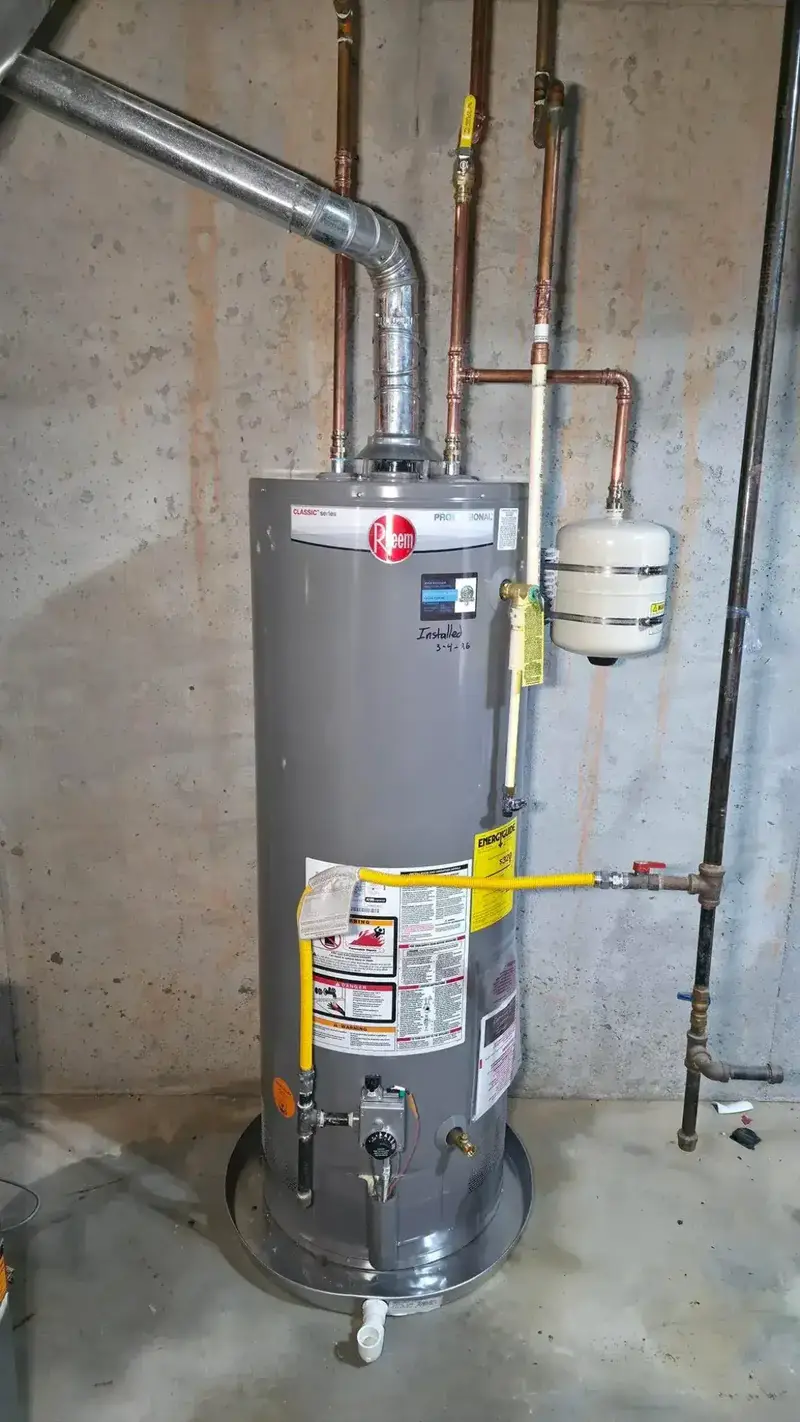
Water heater repair and installation runs about $500 to $2,000, depending on the unit and what the job takes. The estimate is free, and there is no trip fee and no diagnostic fee, so finding out whether you are looking at a valve or a tank costs you nothing. Ryan is a licensed Master Plumber, Georgia license MPR108473, and he will tell you which one it is instead of selling you the bigger number. Full details are on the water heater repair and installation page.
If your tank died at eight years on well water, that is worth talking about before the new one goes in, because the next one will do the same thing under the same conditions. Two things are worth knowing first: what water heater installation actually costs in North Georgia, and whether a tankless or a tank unit makes more sense for a mountain home.
Safe to Handle Yourself vs. Call Now
Plenty of this is yours to do, and doing it makes the repair go faster. Here is where the line sits.
Go ahead and do these:
- Close the cold inlet valve at the top of the heater. No tools, and it stops the feed. This is the right first move every time.
- Cut the power at the breaker, or turn the gas control knob to OFF.
- Dry everything off and find where the water comes back.
- Move anything off the floor that water will ruin.
- Close the drain valve fully, or thread a hose cap onto its outlet.
- Run a hose from the drain valve to a floor drain or outside if you want the tank emptied in a controlled way rather than onto the floor.
Stop and call:
- Water coming through the tank shell. Do not patch it, weld it, braze it, or pour epoxy on it, no matter what a video shows you. The steel around a perforation is rotten across a wide area, not just at the pinhole, and a patch on a pressurized tank fails at 150 PSI worth of scalding water. There is no product on a shelf that fixes a corroded tank.
- Water at the T&P discharge tube. Something is driving pressure past the valve's rating, and that needs a look.
- Any gas smell, scorch marks, or soot around the burner. Do not relight it. Get out and call from outside.
- Standing water near an electric unit, its wiring, or the disconnect.
- Water spreading toward finished flooring or drywall, or anything you cannot dry out in a day.
Ryan answers his own phone, day or night, and text gets through fastest in the mountains. Send a photo of the base of the tank and the discharge tube and you will get a straight answer about what you are looking at.
Common Questions
Is a leaking water heater an emergency?
It depends on where it is leaking and how fast. A drip at the drain valve can wait until morning. Water coming out from under the tank cannot, because a perforated tank can open up without warning and put 40 to 80 gallons on your floor. Either way, close the cold inlet valve and cut the power or gas first. That takes the urgency out of it. We answer day and night, so call or text and describe what you are seeing.
Can a leaking water heater tank be repaired?
No. If water is coming through the tank shell, the steel has corroded through from the inside and the unit has to be replaced. Patching, welding, or sealing a pressurized tank does not hold and is not safe. Leaks at the T&P valve, the drain valve, or the fittings on top are a different story. Those are usually repairable.
How long should a water heater last around here?
Eight to twelve years for a tank unit. On well water with high mineral and iron content, which is common in the mountains, the sacrificial anode rod burns down faster and the tank can fail at the early end of that range. If yours is over eight years old and leaking from the bottom, age is likely your answer.
What does it cost to fix or replace a leaking water heater?
Water heater repair and installation runs about $500 to $2,000 depending on the unit and what the job takes. Estimates are free, and there is no trip fee or diagnostic fee. Ryan will look at it and tell you whether you are looking at a valve replacement or a new heater.
Water is dripping from a pipe running down the side of my heater. Is my tank bad?
Probably not. That pipe is the T&P discharge tube, and it connects to the temperature and pressure relief valve, not the tank shell. It means either the valve is relieving real pressure in the system or the valve itself has stopped sealing. Both are repairable. Do not cap that tube. It is a safety device.
Related Pages
More on problems that show up alongside this one:
- No hot water at all, the other way a failing heater announces itself.
- Burst pipe, if water is coming from somewhere other than the heater.
- Low water pressure, often tied to the same mineral buildup that shortens a tank's life.
- All plumbing problems, the full index.
- Water heater repair and installation, what we do and how it works.
- Water heater installation cost in North Georgia
- Tankless vs. tank water heater for a mountain home
Water Under Your Heater Right Now?
Call or text. Send a photo of the base and Ryan will tell you what you are looking at.