You turned on the shower and got nothing but cold. Every hot tap in the house is the same. That actually narrows things down fast, but the path to the answer is different for a gas heater than an electric one. Here is how to work through it.
First: No Hot Water, Not Enough, or Lukewarm?
These three sound like the same complaint and they are not. Sort yours before you touch anything, because they point at completely different parts.
No hot water at all. Every hot tap runs cold and never warms up, no matter how long you let it run. The heater is not making heat. Something cut off the energy: gas, electricity, or the control that lets either one through.
Not enough hot water. It starts hot, then goes cold in five or ten minutes. The heater works. The problem is capacity: a dead lower element on an electric unit, sediment stacked on the bottom of the tank, or a broken dip tube sending cold water straight to the outlet.
Lukewarm and never hot. Warm at every tap but never actually hot. On electric that usually means a thermostat out of calibration or one element cycling wrong. On gas it can be a burner not staying lit long enough, or a control valve that has lost its setting.
This page covers the first one. If yours is the second or third, the mechanism is different and so is the fix. And if the water still gets hot but barely trickles out, that is a flow problem, not a heat problem. Read why hot water pressure goes low instead.
Step One: Gas or Electric?
Look at the heater before you look anything up. If a gas line runs into a control valve near the bottom of the tank and a flue pipe leaves the top, it is gas. If the only thing feeding it is a thick electrical cable running into the top, it is electric. Almost every no-hot-water call comes down to a short list of failures, and which list depends entirely on this answer.
Gas Heater: Work Through It in This Order
Check the pilot. Older tanks have a small sight glass at the bottom of the burner housing. You are looking for a steady blue flame. Newer sealed-combustion units use an igniter instead of a standing pilot and have a status light that blinks a fault code. If the pilot is out, that alone explains cold water at every tap in the house.
Relight it once, following the label on the tank. Every heater has the manufacturer's relighting steps printed on the side. Use those, not a video of a different model. What happens next tells you most of what you need to know:
It lights and stays lit. The pilot blew out. That happens after a gas interruption, a downdraft, or a heater sitting unused through a cold stretch. Give it thirty to sixty minutes and check a hot tap.
It lights, then dies within seconds of you releasing the knob. That is the classic thermocouple failure. The thermocouple is a thin metal probe that sits in the pilot flame and generates a tiny millivolt current. That current is the only thing telling the gas valve a flame exists and it is safe to keep gas flowing. When the probe corrodes or weakens, the valve reads no flame and shuts the gas off on purpose. It is a safety device doing its job, and it is a small, inexpensive part.
It will not light at all. Check whether gas is even reaching the house. Try the range or the furnace. If those are dead too, it is supply, not the heater. On propane, look at the tank gauge. An empty propane tank is one of the most common no-hot-water calls we take, and it is especially common at cabins that sit empty for weeks. Also confirm the gas shut-off at the heater is open, handle parallel to the pipe.
Pilot stays lit but the burner never fires. The gas control valve, the assembly with the temperature dial on it, is failing. It is not a homeowner repair, and on a tank that is already ten years old it usually turns the conversation from repair into replacement.
If you smell gas, stop reading and get out. Do not relight anything, do not flip a switch, do not open the garage door opener. Get everyone outside, then call from outside. Ryan does gas leak detection and answers day or night.
Electric Heater: Work Through It in This Order
Start at the breaker panel. An electric tank runs on a double-pole 240 volt breaker, usually 30 amp. Look for one sitting in the middle position or flipped fully off. Reset it once: push it firmly all the way to off, then back to on.
It holds. Give it time. A 50 gallon electric tank needs roughly an hour or more to recover from stone cold, so do not judge it after ten minutes.
It trips again right away. Stop there. An immediate trip means something is faulting, and on a water heater that is almost always an element that has shorted or gone to ground inside the tank. Resetting it over and over does not fix it and it pushes real current through a failed part. Leave it off and call.
Then check the high-limit reset. Behind the upper access panel, under a cover plate and a layer of insulation, there is a red button. That is the ECO, the energy cut-off. It trips when the water in the tank gets too hot, generally somewhere around 180 degrees. Pressing it once is reasonable, and sometimes that is the whole fix. But understand that it did not trip for no reason. If it pops again, a thermostat is stuck closed or an element is failing, and it will keep popping until the part is replaced. That is where you stop.
The elements. A standard electric tank has two heating elements, upper and lower, commonly 4500 watts each. Which one died changes the symptom, and that is why sorting the symptom first matters:
Upper element dead: no hot water at all. The upper thermostat runs first in the heating sequence, so when that element is gone, nothing heats.
Lower element dead: a small amount of hot water that runs out fast, or lukewarm water. The top of the tank still heats.
Elements get tested with a multimeter for continuity, with the breaker off, and that is where most homeowners should hand it over. The terminals under that access panel are live at 240 volts whenever the breaker is on, and nothing about the panel warns you. Never pull that cover with power on.
When the Tank Itself Is Done
A tank water heater lasts about 8 to 12 years. Well water shortens that. Plenty of homes out here run on wells, and the water tends to be high in minerals and iron, which is hard on the anode rod and hard on the glass lining inside the tank. Once the lining goes, the steel behind it rusts from the inside out.
Here is the honest version of what waiting costs. A cold shower is an annoyance, not an emergency, and nobody should scare you into a same-day replacement over one. But a tank that quit because it rusted through is a different situation. Forty or fifty gallons on a finished floor, or down into a crawlspace, is a real repair bill on top of the heater. If you have no hot water and you see moisture at the base, rust streaks down the shell, or you have been listening to it rumble for months, that heater is not asking for a part. If you are already finding water around it, read water heater leaking next.
Ryan will tell you straight which side of that line yours is on. A thermocouple or an element in a tank under about eight years old is worth doing. A new gas control valve in a fifteen year old tank is a good part going into a bad tank, and he will say so rather than sell it to you.
Tankless Units Fail Differently
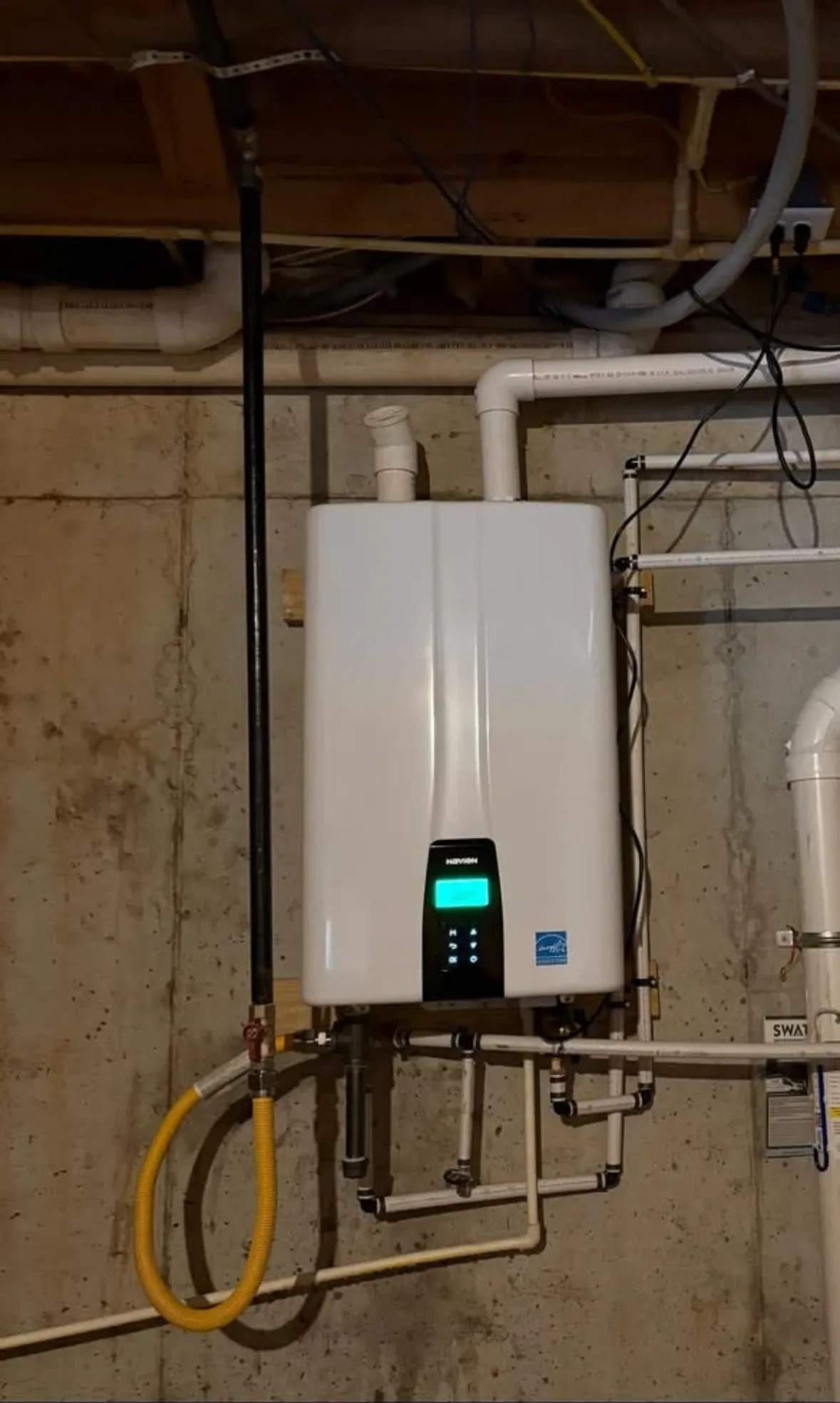
A Navien tankless unit Ryan installed. No tank, no pilot, no elements sitting in water, so it fails in its own way.
If you have a tankless unit, throw out most of the above. There is no standing pilot, no tank of water, and no elements to burn out.
Read the error code first. The display shows a code when the unit locks out. Write it down before you call. Nothing else you can do cuts the diagnosis time more.
Minimum flow rate. A tankless unit will not fire until enough water is moving through it, commonly around 0.5 gallons per minute. A trickling tap or a badly clogged aerator can drop below that trigger and hand you cold water from a perfectly healthy unit.
Scale on the heat exchanger. This is the big one on high-mineral well water. Minerals bake onto the exchanger, the unit runs hotter and less efficiently, and eventually it throws faults or shuts down entirely. Descaling every one to two years is normal maintenance here, not an upsell. If yours has never been serviced, start there.
Power. Even a gas tankless unit needs electricity for its controls and fan. A tripped breaker or an unplugged unit kills it completely, and people rule out electric problems because the unit burns gas.
Water heater repair and installation runs about $500 to $2,000, depending on what failed and what goes back in. A thermocouple sits at the bottom of that range. A full tankless installation with new gas and venting sits at the top. The estimate is free, there is no trip fee, and there is no diagnostic fee, so finding out which one you are looking at does not cost you anything. Ryan gives you the number before he starts, and the workmanship is guaranteed on every job. More detail on the whole service is on the water heater repair and installation page.
Safe to Handle Yourself vs. Call Now
Some of this is genuinely a five minute homeowner fix. Some of it will hurt you. Here is the line, plainly.
Safe to do yourself
Relight a gas pilot, following the manufacturer's label printed on the tank
Reset a tripped breaker. Once.
Press the red high-limit reset button behind the upper access panel. Once.
Check whether your other gas appliances still work, and read the propane tank gauge
Confirm the gas shut-off valve at the heater is open, handle parallel to the pipe
Confirm nobody turned the temperature dial down or left it on vacation mode
Clean a clogged aerator if you are on tankless and the flow looks weak
Write down the error code on a tankless display
Stop and call
You smell gas. Leave the house first. Call from outside. Do not relight, do not flip switches.
The breaker trips again after one reset. Something is shorted.
The high-limit button pops again after one reset.
The pilot dies every time you release the knob.
You are looking at element wiring. Do not touch it with the power on, ever.
The combustion chamber is sealed. Do not open it. Sealed means sealed for a reason.
There is water at the base of the tank or rust running down the shell.
The tank is past ten years old and the failed part is expensive.
Ryan Chastain is a licensed Master Plumber, Georgia license MPR108473. He answers the phone himself and usually does the work himself. If you are not sure which side of the list you are on, text him a photo of the heater and the data plate. That is often enough to tell you before anyone drives out.
Common Questions About No Hot Water
Why does my pilot light keep going out?
If it lights but dies the moment you release the gas control knob, the thermocouple is the usual answer. It is the probe sitting in the pilot flame that tells the gas valve a flame is present. A weak or corroded thermocouple makes the valve think the flame is gone, so it shuts the gas off. It is a small part and a common repair. If the pilot stays lit for hours and then blows out repeatedly, look at drafts, a dirty pilot orifice, or venting instead.
I reset the breaker and it tripped again. What does that mean?
It means a part is faulting, and on an electric water heater that usually means an element has shorted or gone to ground inside the tank. Leave the breaker off. Resetting it again will not clear anything, and repeatedly forcing current through a failed element is not something to experiment with. That one is a call.
How long should a water heater last?
About 8 to 12 years for a tank unit. Well water with high mineral and iron content, which is common in the rural areas around here, pulls that toward the short end. If your tank is at the top of that range and something major just failed, replacement is usually the better math.
Is it worth repairing an old water heater or should I replace it?
It depends on the age and the part. A thermocouple, an element, or a thermostat in a tank under about eight years old is worth repairing. A failed gas control valve in a twelve or fifteen year old tank is putting a good part into a tank that is near the end anyway. Water heater repair and installation both run about $500 to $2,000. Ryan quotes both options free and tells you which one he would do.
My tankless unit has no hot water. Is it the same problem?
No. Tankless units have no pilot, no tank, and no elements, so the failures are different. Start with the error code on the display, then check that the unit still has power, since even a gas tankless needs electricity to run. After that, the most common cause here is scale on the heat exchanger from high-mineral well water. Descaling every one to two years prevents most of it.