
Plumbing emergency? Burst pipe, no water, sewer backup. We respond day and night. Call or Text (706) 669-5727
Plumbing Problems
Orange or Rust Stains in Sinks and Tubs
Orange or reddish brown staining on porcelain is almost always iron. The part that throws people off is that the water can look perfectly clear coming out of the tap and still stain everything it touches. Here is why that happens, and what actually stops it.
Clear Water That Still Leaves Rust Behind
Underground, in the aquifer, there is no oxygen. Iron sits in the water dissolved, in a form called ferrous iron, and dissolved iron is invisible. You can pour a glass and it looks fine, because it is clear.
The moment that water meets air, the chemistry changes. Oxygen converts the dissolved iron into ferric iron, which will not stay in solution. It drops out as rust particles. That happens at the faucet, in the toilet tank, on the shower wall, on wet laundry sitting in the washer. Then the rust bonds to the porcelain glaze and to fabric.
So an orange stain is not proof that dirty water came out of your tap. It is proof that iron came out of your tap and then met air. That is the single most confusing thing about this problem, and it is why people spend months scrubbing fixtures and replacing faucets when the fixture was never the issue. Well water is common in the rural parts of North Georgia, and the water here tends to run high in minerals and iron, so this is a regular call.
What It Costs You to Live With It
Iron staining is not an emergency. Nothing is going to flood, and you are not going to wake up to a disaster. But it does not hold still either, and the cost is real:
- Stains cure. Fresh iron stain wipes off with the right cleaner. The same stain left on a tub for a year works its way into the glaze and into grout. At that point you are pricing a replacement, not a cleaner.
- Laundry is where it gets expensive. Whites and towels come out of the wash with an orange cast that never fully leaves, and the usual instinct is to reach for bleach, which makes it permanent. More on that below.
- It builds up where you cannot see it. Iron leaves the same deposits inside a water heater, a dishwasher, an ice maker, an aerator, and a shower cartridge that it leaves on the tub. Aerators clog first because they are the smallest opening in the system.
- The taste. Iron gives water a metallic, penny-like edge. It shows up hardest in coffee and tea, and in ice.
Three Kinds of Iron, and Why the Difference Decides the Fix
Iron does not show up one way. Three versions cause staining, and each one needs different equipment. Getting this right before anyone buys anything is most of the job:
- Clear water iron. Dissolved, ferrous, invisible. The water is clear in the glass and the stains appear later, after water has sat on a surface and dried. This is the most common version on well water and the hardest one to believe, because the water looks clean.
- Red water iron. Already oxidized before it reached you. The water comes out of the tap tinted orange or rusty, sometimes with visible specks. This is a particle, not a dissolved mineral, which changes everything about how it gets removed.
- Iron bacteria. Not a mineral problem at all, a living one. It looks like reddish brown slime or sludge rather than a stain. It collects in the toilet tank, sometimes with an oily looking sheen on the water surface, and it can carry a swampy or musty smell. It fouls well screens, pumps, and softener resin. This one gets handled differently from the other two.
You can sort out which one you have for free, in about an hour, before anyone comes out. Fill a clear glass straight from the tap and look at it right away, then set it on the counter and look again an hour later:
- Clear at first, orange sediment settled on the bottom after sitting: clear water iron.
- Tinted or rusty the second it leaves the tap: red water iron.
- Now lift the lid off your toilet tank. A rust ring at the waterline points to iron. Reddish brown slime you can feel between your fingers points to iron bacteria, and that is a different conversation.
One more thing worth ruling out: if the staining looks closer to brown black than orange, that can be manganese instead of iron. It often travels alongside iron in well water. A test tells you which you are dealing with, and it matters, because manganese is treated differently.
If Only the Hot Water Stains, Your Well Is Not the Problem
Before anyone spends a dollar on water treatment, check this. Run cold water into a white sink and look. Run hot water into the same sink and look. Do it at two fixtures, in different parts of the house.
If the cold runs clean and the hot runs rusty, your water supply is fine. Your water heater is rusting from the inside out.
Here is the mechanism. A tank water heater is steel with a thin glass lining, and that lining always has small gaps in it. To keep the exposed steel from corroding, the tank carries a sacrificial anode rod, a magnesium or aluminum rod that is designed to corrode instead of the tank. It gets consumed over time, commonly in the range of 3 to 5 years, and faster on softened or aggressive water. Once the rod is spent, the tank steel is next in line. Rust that shows up in the hot water only is one of the earliest signs.
Age decides the answer. If the heater is 8 to 12 years old and the hot water is rusty, the tank is usually on its way out and replacement is the honest call. If it is much newer, replacing a spent anode rod can buy real years. Either way that is a water heater job, not a water treatment job, and water heater repair or replacement runs about $500 to $2,000 depending on the unit. If you are also running out of hot water entirely, that is a separate diagnosis: see no hot water.
And if both hot and cold stain, the heater is not your culprit. It is what is coming into the house.
Why a Water Test Comes Before Equipment
A lot of water treatment equipment gets sold to people who did not need that particular piece of equipment. Here is the honest version of what each thing does:
- A softener handles low levels of clear water iron. Softeners are built to remove hardness, and ion exchange picks up some dissolved iron on the way through. Manufacturers rate them for low levels only. Push more iron than that through one and the resin fouls, the softener quits softening, and you have bought yourself a second problem.
- A softener does nothing for iron that has already oxidized. Red water iron is a particle by then. It plugs resin instead of getting exchanged.
- A sediment or cartridge filter does not remove dissolved iron. This is the one that costs people the most money for the least result. Dissolved iron is not a particle yet, so it passes straight through the cartridge and oxidizes on the other side. You changed a filter, and the stains never stopped.
- Higher iron needs dedicated iron filtration. These systems oxidize the iron on purpose, upstream, before it ever reaches a fixture, then catch it in a filter bed. That is different equipment, and it has to be sized to the actual iron level and to the flow rate of the house.
- Iron bacteria has to be killed first. Filtration alone does not solve a living colony. That generally starts with shock chlorinating the well, and what comes after depends on whether it returns.
Five problems, five different answers, and the only thing that tells you which one is on your property is a water test: iron level, whether it is ferrous or ferric, hardness, manganese, pH, bacteria. That is why the test comes first. Guessing at equipment is how a homeowner ends up with a system that runs, costs money every month, and does not stop the stains.
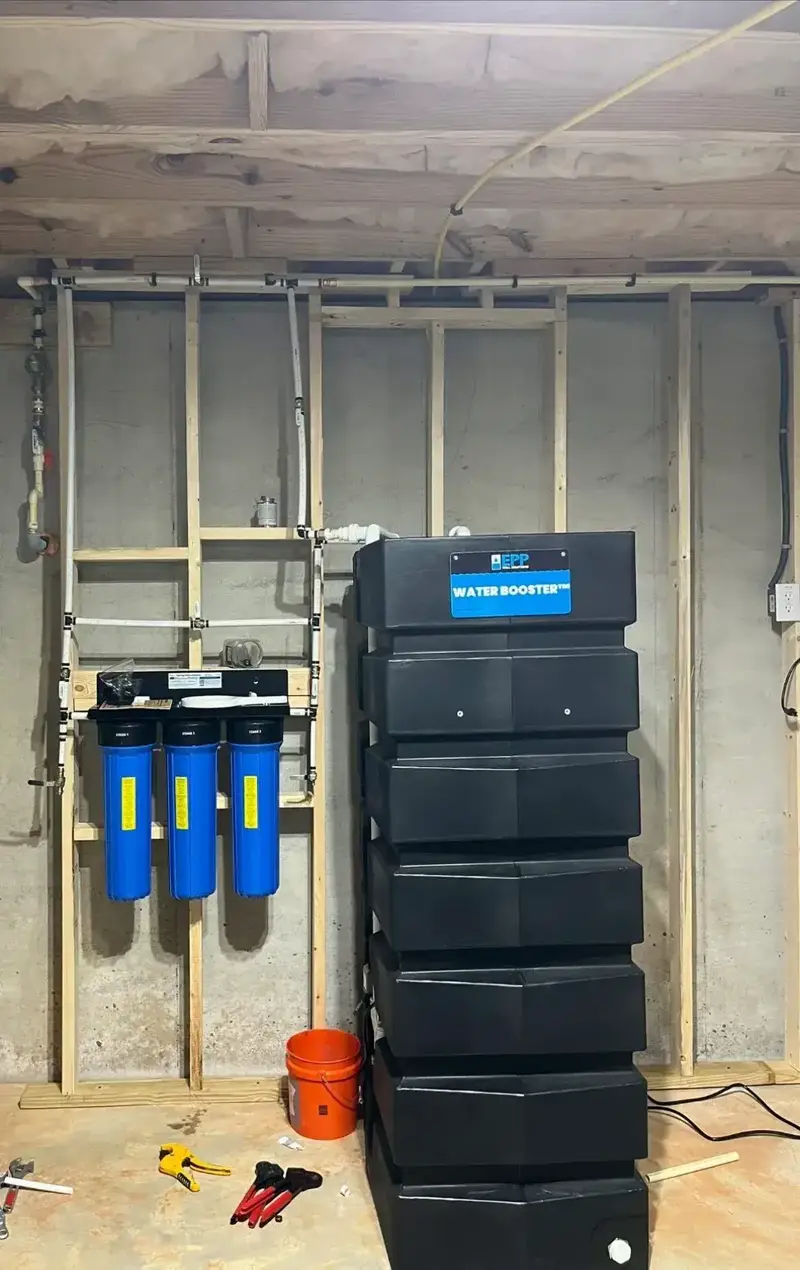
Water treatment and filtration is a free estimate, with no trip fee and no diagnostic fee. Ryan will look at the well setup, look at the fixtures, read the test, and tell you what will actually fix it. If a softener on its own will do the job, he will tell you that too. If you want to understand the difference before he gets there, start with water filtration vs. water softener, and what hard water does to plumbing in Georgia covers the mineral side of the same water.
Two related problems people often lump in with this one, wrongly. Iron and iron bacteria are hard on a well system, so if you are also hearing the pump kick on and off rapidly, that has its own causes: see well pump short cycling. And orange staining down in the drain alongside a sink that empties slowly is almost always two separate things happening at once, because slow drainage is a clog, not water chemistry: see slow draining sink.
Safe to Handle Yourself vs. Call Now
You can do these today
- Clean the stains that are there. Use a rust remover made for the surface. Oxalic acid based cleaners are the standard for porcelain and vitreous china, and they lift iron faster than most people expect. Read the label before using anything acidic on a tub with a worn or colored finish, and keep acid off natural stone.
- Run the glass test and lift the toilet tank lid. Both are free, both take an hour, and both narrow the problem down considerably. Write down what you saw.
- Check hot versus cold at two fixtures. That one answer sends the job in two completely different directions, water heater or water supply.
- Note when it started. Staining that showed up suddenly on a well that was fine for years usually means something changed at the well. A slow drift over years points somewhere else.
Do not reach for the bleach
This is the one that catches almost everybody. Chlorine bleach is an oxidizer, and a rust stain is already oxidized iron. Bleach takes whatever dissolved iron is still present and turns it into more rust, right there on the surface you are trying to clean. On porcelain it darkens and sets the stain instead of removing it. On laundry it sets an iron stain permanently, and there is no undoing that afterward. Use an acid based rust remover on both the fixture and the clothes.
Where it stops and you should call
- Getting the water properly tested, and reading what the result actually means. The numbers pick the equipment.
- Sizing and installing treatment to that test and to the flow rate of your house, so it works at every fixture and not just the closest one.
- Anything involving the well itself, including shock chlorination for iron bacteria.
- Rust in the hot water only, which is a water heater call and often a timing decision about repair versus replacement.
- Any of it, honestly, if you would rather not chase it. There is no trip fee and no diagnostic fee, so having Ryan look costs you nothing.
Common Questions About Orange and Rust Stains
Is orange water safe to drink?
Iron at the levels that cause staining is treated as an aesthetic problem rather than a health one. The federal standard for iron is a secondary standard, set at 0.3 milligrams per liter for taste, color, and staining, not for safety. That said, on a private well nobody is testing your water but you, and iron usually shows up with company: manganese, sulfur, sometimes bacteria. The stains are just the part you can see. A test tells you what else is in there.
Why does bleach make rust stains worse?
Because bleach is an oxidizer and a rust stain is already oxidized iron. Adding bleach converts any dissolved iron that is present into more rust, on the spot. On porcelain it darkens and sets the stain. On laundry it sets it permanently. Use an acid based rust remover instead, usually oxalic acid, on both the fixture and the clothes.
Will a water softener get rid of my orange stains?
Sometimes. A softener will handle low levels of dissolved clear water iron along with the hardness. It will not handle higher levels, it will not handle iron that has already oxidized into particles, and it will not handle iron bacteria. In those cases the iron fouls the resin and the softener stops working. That is the whole reason to test before buying: a softener is the right answer sometimes and the wrong answer sometimes, and only the test tells you which.
Why do only my hot water fixtures have rust stains?
That points at the water heater, not the well. Cold water running clean means what is coming into the house is fine. Inside a tank heater, a sacrificial anode rod corrodes so the steel tank does not. Once that rod is used up, commonly somewhere around 3 to 5 years in, the tank itself starts rusting and you see it in the hot water only. On a heater over 8 years old, that usually means the tank is on its way out.
Can I get rid of the stains that are already there?
Yes. Existing iron stains come off porcelain with an oxalic acid based rust remover, and they come off faster than people expect. The catch is that they come straight back. Cleaning is cosmetic. Until the iron stops arriving at the fixture, you are on a cleaning schedule forever.
Related Pages
More on well water, iron, and the problems that get confused with this one.
The service that fixes this
Other plumbing problems
Worth reading
Find Out What Is Actually in Your Water
Free estimate, no trip fee, no diagnostic fee. Call or text Ryan and describe what you are seeing. Text gets the fastest response.